Sicily is the largest island in Italy and in the Mediterranean, a surprising land rich in history and traditions, where art and culture are mixed with wonderful natural beauty. From the sea to the mountains passing through the countryside, volcanoes and seaside villages, there are so many reasons to visit this land. The island it’s also known for its delicious food, in fact there are many great typical dishes, sardine a beccafico, Palermo-style timbale, arancine, caponata, panelle end many more, but the greediest ones are the desserts.
Of course, the island it’s plenty of sweets to die for, today I will describe you my favorites, what I call the King and the Queen.
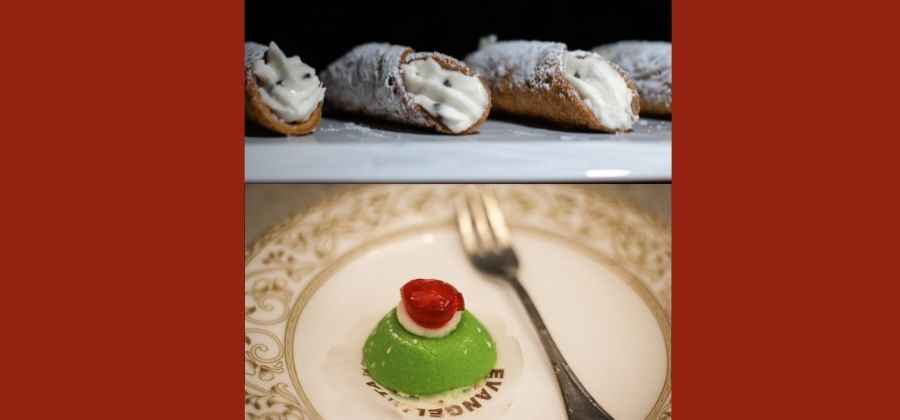
Let’s start with the King, the Sicilian Cannolo, basically a pastry consisting of tube-shaped shell of fried pastry dough, filled with a sweet, creamy filling usually containing sheep ricotta and chocolate chips, decorated with powdered sugar, chopped dried fruit or candied fruit. Several legends about it. Some food historians place the origins of cannoli in Caltanissetta, the City of Women, by the concubines of a prince looking to capture prince’s attention. Another legend determine that cannoli come from the Palermo and Messina areas and were historically prepared as a treat during Carnevale season, possibly as a fertility symbol.
If you think that cannoli are very sweet, wait to taste the Queen of the Sicilian desserts, the Sicilian Cassata.
Colorful and very yummy it’s a round sponge cake, moistened with fruit juices or liqueur and layered with sheep ricotta cheese and candied fruit, the shell is made of marzipan, pink and green colored icing, and decorative designs. It seems that the cassata originated with the Arabs who lived in Palermo during the 11th century, when Palermo was the largest city in Europe. According to tradition, one night a shepherd decided to mix sheep’s milk ricotta with sugar and he called this dessert “quas’at” (“bowl”), from the name of the bowl in which the dough was contained. The colorful variant known today is the result of an evolution of the invention, at the Martorana convent in Palermo, of pasta reale (or pasta martorana), based on almond flour. Initially a pastry and later sponge cake, the cassata as we know it today is due to Salvatore Gulì, who was, at the end of the 19th century, the true protagonist of the Sicilian Cassata, as well as one of the greatest pastry chef of all times.
To pair these “royal” desserts with wine, we asked Federico Latteri, a great friend and wine expert, who writes for www.cronachedigusto.it and is the curator of the guide Guida ai Vini dell’Etna. He recommends for both desserts:
Marsala Superiore Ambra Semisecco D.O.C. Vintage 1994 Heritage Francesco Intorcia
Moscato Passito di Pantelleria D.O.P. Decennale 2009 Ferrandes
For any further information contact me on
stefaniamontalbano@carlozucchetti.it